
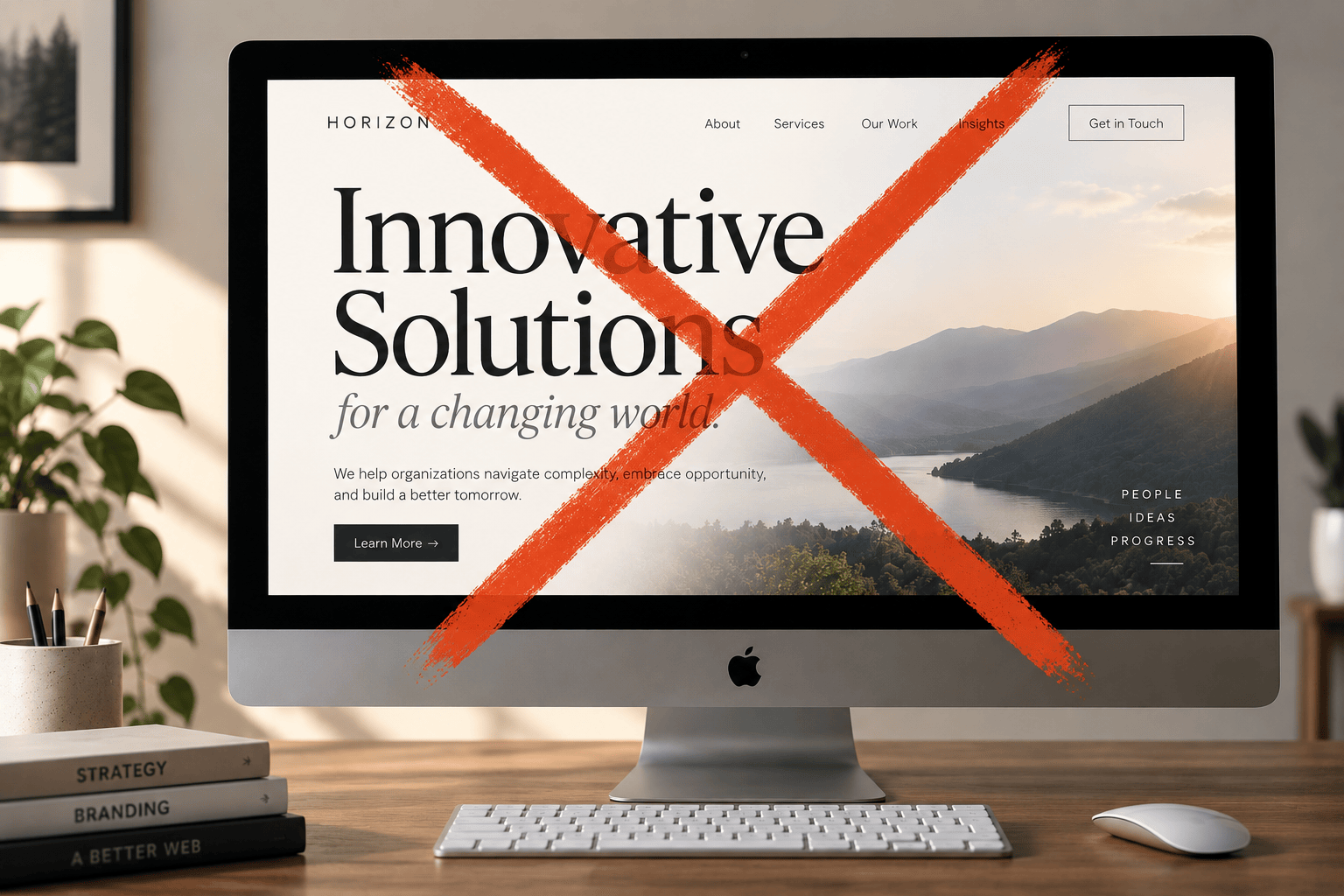
These days, a great-looking website isn’t enough. Strange thing for a web designer to say? Not at all. Obviously, websites should look good. Typography, photography, color, hierarchy, spacing, usability and polish — they all matter.
But looking professional is just table stakes. That first credible impression only buys a few more seconds of attention.
A beautiful-looking website can still leave a visitor with no clear idea what makes a business different, who it’s actually for, or why they should choose you instead of one of the other five tabs they have open.
And if that happens, the problem usually isn’t the design. It’s the promise. You need a super-clear website value proposition.
What does your business actually promise?
Every effective website needs to answer one basic question:
What can you do for me that is specific enough for me to understand, imagine, feel, want, and remember?
Businesses often answer that question with language that sounds professional but could belong to anybody.
- “Committed to excellence.”
- “Solutions designed around you.”
- “Helping businesses grow.”
- “Adventure starts here.”
- “Building stronger communities.”
- “Your trusted partner.”
You know these phrases. You hate these phrases. Everyone hates these phrases! They’re marketing wallpaper. Not necessarily false, just so universally agreeable that, really, they communicate nothing.
If your competitors can copy a sentence from your homepage, paste it onto theirs and have it make just as much sense, then those words aren’t doing nearly enough work as far as differentiating your brand goes.
A strong promise identifies a combination of who you serve, what you provide, what problem you solve, what changes as a result, and why your particular approach matters.
Once you have that, you have something to sell.
Related…
What are people really buying from you?
The answer is rarely just the product or service itself. The website value proposition is how you connect what you sell to what your customer actually wants.
A bakery sells bread, cakes and pastries. But that’s only the transaction. People are really buying a small physical pleasure on the way to work, a birthday ritual, something beautiful to bring to someone’s house, or a neighborhood place where the person behind the counter knows their name. Baked goods are intrinsically pleasurable and very often social.
A nonprofit doesn’t simply offer programs. Depending on its mission, it could be offering a donor the opportunity to feed someone, protect a place they love, change an unjust system, preserve something for the next generation, or simply participate in a community they want to exist.
A virtual assistant sells administrative support. But what the client is really buying is time back. Hours that would otherwise disappear into scheduling, inboxes, invoicing and routine tasks can instead be spent on higher-level entrepreneurial thinking, planning, selling, or just doing the work that only the business owner can do.
A gym sells access to weights, treadmills and exercise classes. But nobody joins because they’ve always dreamed of having access to twelve different resistance machines. They’re buying the possibility of a future self: stronger, fitter, healthier, more attractive, more confident, more capable.
A financial adviser sells financial planning. But the client is buying something much more emotional: the ability to stop wondering whether they’re going to be okay.
A landscaper sells plants, labor and design. The homeowner might be buying summer evenings outside, a yard they’re proud of, less maintenance every weekend, or a place where their children want to play.
And so on.
What ties these examples together is a better future state. The product or service is the mechanism that gets the customer from where they are now to somewhere they’d rather be.
Your product is the mechanism. Your promise is the better future it helps create.
Once you understand that, you have something much more interesting to sell. And you’re on your way to developing a strong website value proposition.
BTW, if you want a more formal framework for developing one, Shopify has a useful guide to writing a value proposition, including real-world examples and a simple value proposition framework.
What specificity actually looks like
Here are some website value proposition examples.
Consider a solo business consultant.
Instead of: “Helping you reach your full potential.”
Try: “Build a consulting business that earns six figures without working six days a week.”
The first statement could describe a business coach, therapist, personal trainer, university, financial adviser or particularly ambitious yoga instructor. The second tells us who the service is for, what they want and what they don’t want to sacrifice to get it. Now we have something to run with.
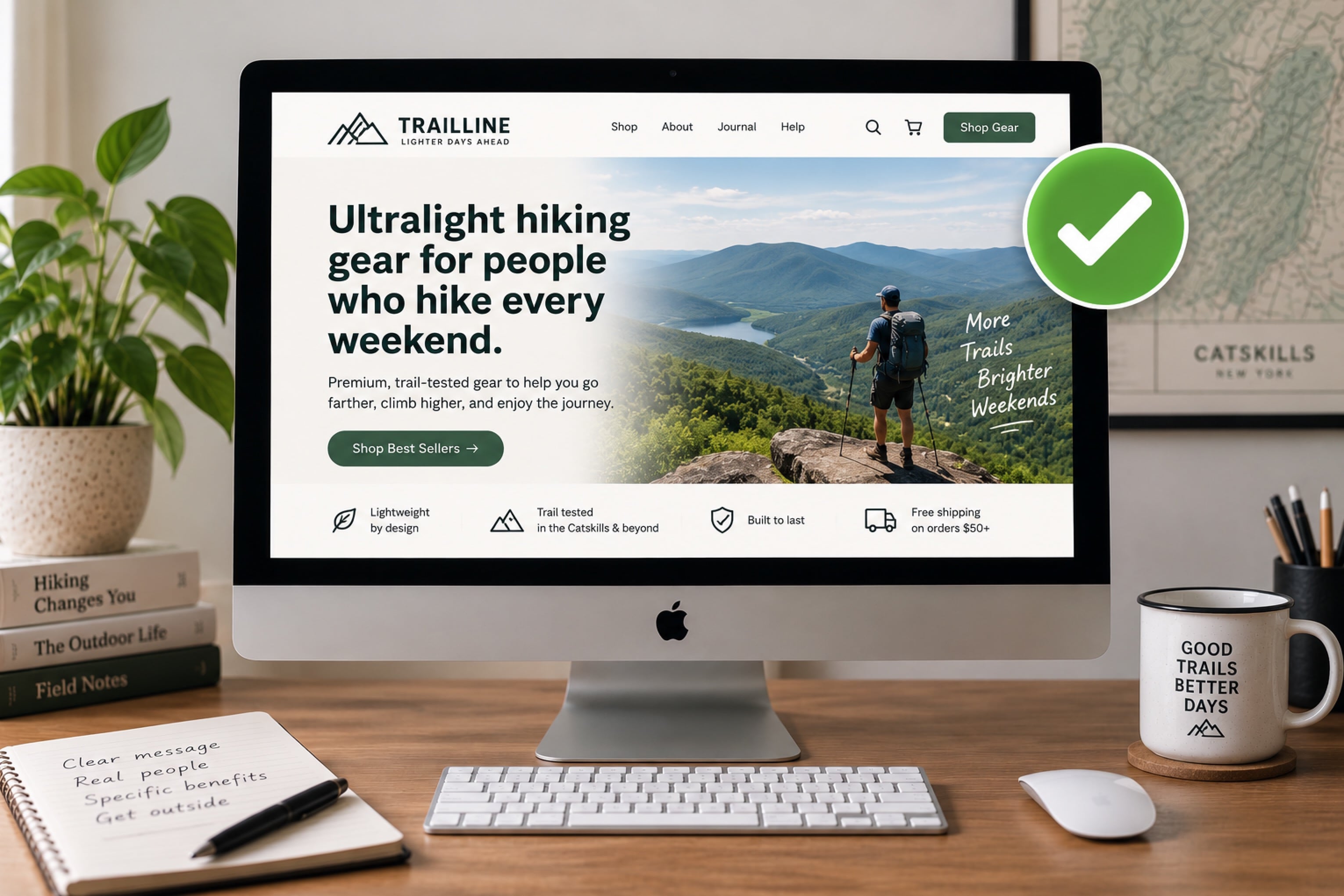
An outdoor brand might move from: “Gear for every adventure.”
to: “Ultralight hiking gear for people who hike every weekend.”
The second version deliberately excludes people. That’s fine. In fact, that’s more of a feature than a bug. The brand has identified the person it wants to speak to and given that person a clear identity signal: this is for people like you.
A nonprofit might move from: “Building stronger communities together.”
to: “Help us put a hot dinner in front of 500 Hudson Valley families every week.”
The first tells me that the organization is presumably doing something worthwhile. The second lets me actually imagine the work.
Concrete-and-local always beats worthy-but-vague.
More website value proposition examples
Vague language is everywhere, particularly in industries where businesses have spent years looking at one another’s websites.
An accountant says: “Accounting solutions you can trust.”
Try: “Monthly bookkeeping for small businesses that want clean books without hiring a finance department.”
A therapist says: “Helping you live your best life.”
Try: “Therapy for high-achieving professionals who look fine on paper and feel exhausted underneath.”
An architect says: “Designing spaces that inspire.”
Try: “Modern Catskills homes designed around the landscape, not dropped on top of it.”
A financial adviser says: “Your partner for financial success.”
Try: “Financial planning for people within ten years of retirement who need to know whether they’ve actually saved enough.”
A restaurant says: “An unforgettable dining experience.”
Try: “Wood-fired Neapolitan pizza made with Hudson Valley ingredients.”
A photographer says: “Capturing memories that last a lifetime.”
Try: “Relaxed family photography for people who hate posing for photographs.”
A law firm says: “Experience you can trust.”
Try: “Outside general counsel for growing companies that need legal guidance but don’t need a full-time lawyer.”
A landscaping company says: “Bringing your outdoor vision to life.”
Try: “Native landscapes that look beautiful without demanding your entire Saturday.”
A personal trainer says: “Become the best version of yourself.”
Try: “Strength training for people over 50 who want to keep hiking, skiing and moving well for decades.”
A home organizer says: “Transform your space. Transform your life.”
Try: “Practical home organization for busy families who need systems they can actually maintain.”
A marketing consultant says: “Helping brands stand out in a crowded marketplace.”
Try: “Marketing strategy for small businesses that are tired of trying random tactics and hoping something works.”
A contractor says: “Quality craftsmanship you can depend on.”
Try: “Kitchen renovations for older Hudson Valley homes, from first sketch to final inspection.”
And, because web designers should be subjected to their own advice: “Beautiful websites that get results.”
Try: “Strategy-first WordPress websites you’re proud to share in 4–6 weeks.”
There’s nothing magical about any of these sentences. Some would need to be tested, refined and supported with additional messaging before I’d recommend them as a final website value proposition.
The point is that, paradoxically, each gives us considerably more to work with than the generic version.
A promise isn’t necessarily a tagline
I’m not suggesting that every business needs to boil its entire strategy down to one clever sentence and slap it across the top of its homepage.
Your promise is bigger than your headline. It might appear in the headline and supporting copy. It might be expressed through the way you organize your services, the examples you choose, the photographs you use, your testimonials, your case studies, your calls to action and the things you deliberately leave out.
It answers: Why this business, for this person, for this problem?
Think of the promise as the organizing idea. The website then has to make the answer clear.
Hold up! Specific doesn’t mean ridiculous
There’s a temptation in marketing to confuse specificity with increasingly extravagant claims, or ridiculous promises.
TRIPLE YOUR REVENUE IN 37 DAYS!!
Well, that’s specific. Probably also nonsense.
A strong promise doesn’t have to contain a number. A website value proposition doesn’t even necessarily have to promise an outcome. Specificity can come from several places.
Be specific about the audience
“Vet care for anxious dogs and the humans who love them.”
You know immediately if this is talking to you.
Be specific about the problem
“For couples who got engaged and immediately felt overwhelmed instead of excited.”
The specificity comes from recognizing an experience.
Be specific about the outcome
“A house that’s the same temperature in every room, finally.”
Nothing revolutionary there. Just a clearly understood before and after, but with a little nod to the specific frustration we all feel.
Be specific about your approach
“Rooms built around what you already own.”
This proposition tells us something about how this interior designer works.
Be specific about place
“Same-day flower delivery anywhere in the Hudson Valley.”
Geography can make a generic service or abstract offer tangible.
Be specific about what you don’t do
“Legal counsel for growing companies that need a lawyer but don’t need a legal department.”
Sometimes a boundary makes for a clear proposition.
The point isn’t to cram all of these into one sentence. It’s to find a specific website value proposition that’s clear and memorable, and actually matters to your audience.
Specificity means making choices
This is where, for many people, positioning becomes uncomfortable. Businesses often prefer broader language because broad language feels safe.
If you say you provide, “innovative solutions for businesses of all sizes,” you haven’t excluded anybody. A five-person company can hire you. So can a 5,000-person company. You can do this kind of project or that kind of project. Whatever walks through the door, you’re ready.
I understand this impulse. You don’t want to lose a potential customer, client, or donor. Unfortunately, language like this makes your audience do all the work of figuring out whether your offer is particularly suited to them.
Specificity reverses that.
“Monthly bookkeeping for small businesses” tells a Fortune 500 company that this probably isn’t for them. That’s good!
“Ultralight hiking gear for people who hike every weekend” probably isn’t speaking to someone buying a backpack for a once-a-year walk. Also good!
Your offer and positioning should filter out the wrong audience just as much as it filters in the right one.
Positioning becomes useful when it begins making choices.
This is where web design becomes strategic
Once the website value proposition is clear, design becomes so much easier and so much more powerful.
- If your promise is speed and simplicity, the website should feel fast and simple.
- If your promise is deep expertise, the website needs to demonstrate authority and provide evidence.
- If your promise is personal attention, hiding the people behind the business beneath generic stock photography makes no sense.
- If your advantage is local knowledge, a sense of place should be unmistakable.
- If you sell a premium service based on judgment and craft, your typography, imagery, writing and interactions should support that perception.
- If your nonprofit’s work can be measured in meals served, acres protected, animals rescued or families housed, those outcomes shouldn’t be buried halfway down an annual report.
Strategy determines what matters. Design gives it hierarchy, personality and credibility.
The visual design is no longer decoration sitting on top of the business. It should amplify the proposition.
A beautiful website can still be a bad website
This is the uncomfortable part for us designers. We can make almost anything look good. Give a competent designer decent photography, a strong typeface, a restrained palette and enough whitespace and we can make “Innovative Solutions for a Changing World” look extremely expensive.
But that kind of design solution doesn’t solve the underlying problem: a prospective customer still needs to understand the offer, whether it’s for them, why it matters, and why they should believe it.
A beautiful website that fails to answer those questions is still underperforming. Good-looking isn’t good enough.
Before you redesign your website, finish this sentence
Here’s a useful exercise:
People should choose us because…
Finish that sentence, then interrogate the answer.
Not because you care more, or because you’re committed to excellence, or because you provide personalized service, or because your solutions are innovative, or because you put customers first.
Those things may all be true. But every competent competitor can say the exact same thing. You haven’t found the interesting part yet, the part that speaks directly to…
- the pain points your audience has to deal with, and
- what freedom from those pain points might feel like.
What can you say about your business that a dozen competitors couldn’t paste onto their own homepage? That’s where things start getting useful.
If you don’t have a good answer yet, that’s useful information too. A rock solid website value proposition takes time. No website project should begin with colors, fonts, or whether the buttons should have rounded corners. It should begin with this business fundamental: a strong value proposition.
Good-looking isn’t good enough. Good-looking + strategically clear is.
If you’re planning a new website or redesign and want one built around a clear promise, let’s talk.